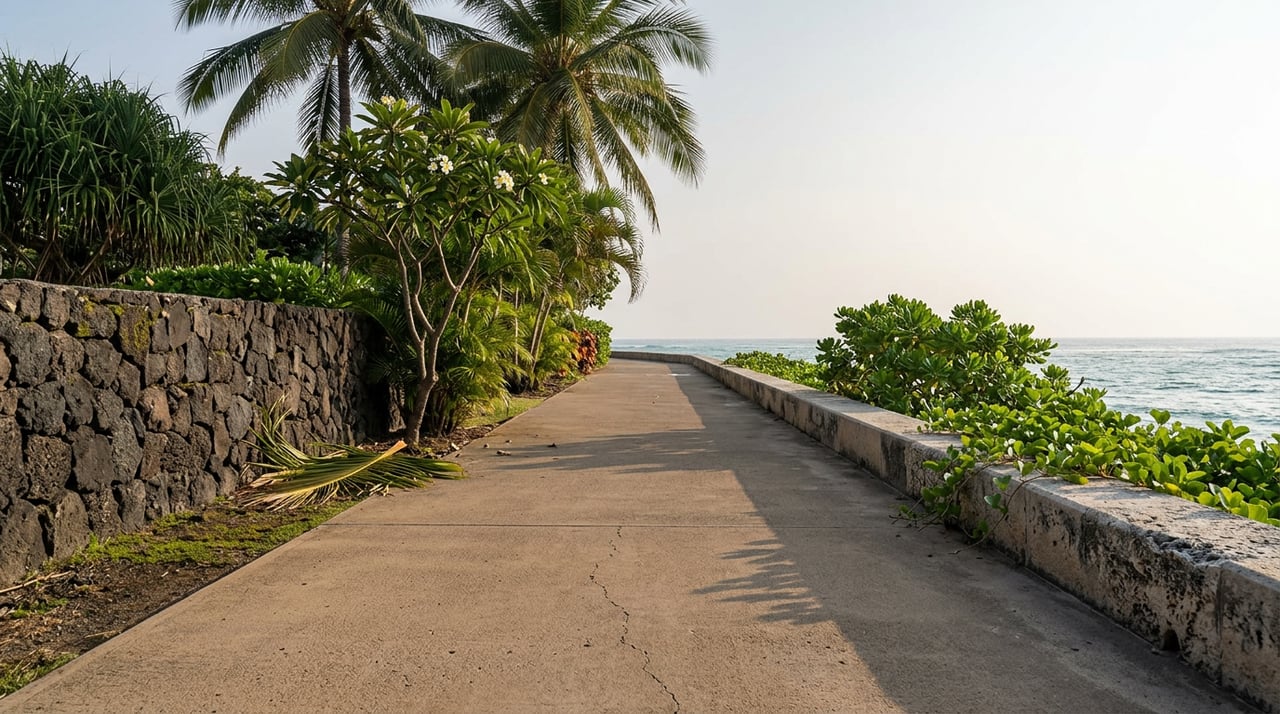
Why does a mile and a half of manicured shoreline, backed by some of the most expensive resort real estate in Hawaii, still let anyone walk it for free? No wristband, no room key, no valet ticket to flash at a gate.
If you've lived in Wailea for any stretch of time, you already know the walk works this way. What most people never stop to ask is why it works this way when almost nothing else along this coast is open to everyone regardless of who's paying for the room.
The Plan That Made This Possible
Wailea wasn't built the way most beach towns grow, one hotel and one property line at a time. It was developed in the 1970s as a single master-planned resort, and the coastal path was part of that plan from the start rather than something bolted on later. The obligation was written in from day one: each resort along the route is responsible for building and maintaining its own stretch of the path, and the intent behind that requirement was to guarantee beach access for the public, not just for guests staying on property.
That single fact changes how you should think about the walk. It isn't a shared amenity that resorts generously extend to the neighborhood. It's a condition of development, which means the upkeep you're standing on at any given moment tracks directly to whichever hotel's landscaping budget backs that segment. Notice a stretch that's freshly edged and immaculately raked, followed by a section that feels a touch more worn? That's not random maintenance drift. That's two different HOAs with two different quarters.
The surface under your feet tells the same story. Near the northern end, close to Keawakapu, the path is still sand rather than pavement, because it's illegal on Maui to pave over a natural dune. Head south and it transitions to boardwalk before finally becoming full pavement for the remainder of the route. That shift isn't a design choice made for variety. It's Hawaii's dune protection law showing up literally underfoot.
Here's roughly how the frontage breaks down, north to south:
| Beach | Resort Frontage | Notes |
|---|---|---|
| Mokapu Beach | Andaz Maui at Wailea Resort | Northernmost of the connected beaches, roundabout drop-off, family-friendly |
| Ulua Beach | Between Mokapu and Wailea Beach | Best snorkeling on the route, lava outcroppings hold the most reef fish |
| Wailea Beach | Grand Wailea and Four Seasons Resort Maui at Wailea | The half-mile golden crescent most people picture when they hear "Wailea" |
| Polo Beach | The Fairmont Kea Lani, near Polo Beach Club | Southern terminus, more swell, quieter sand |
How Many Beaches Does This Walk Actually Touch?
Ask around and you'll get different answers, which is itself a useful piece of local knowledge. A travel writer's piece describing the walk as passing five beaches touched off a genuine debate on a Maui forum in February 2026, with longtime visitors and residents arguing back and forth over whether Keawakapu counts as a fifth stop on the route. The disagreement isn't really about counting. It's about the fact that Keawakapu isn't connected by any paved or boardwalk section at all. To reach it from the main path you're walking on open sand until you meet up with the paved route that starts near the Andaz. Call it four beaches on a built path with one bonus beach if you're willing to get sand between your toes to reach it.
The Museum You Walk Through Without a Ticket
Somewhere around the midpoint of the walk, the path runs directly past Grand Wailea, and most people who live nearby have no idea that the resort houses one of the largest privately held art collections in the state, more than 80 museum-quality pieces spread across the property. Nine bronze sculptures by Colombian artist Fernando Botero anchor the lobby. A run of seventeen bronze reliefs by French modernist Fernand Léger lines the corridor leading into the resort's NaPua Gallery. Near the entrance stands a bronze statue of Kamehameha I by artist Herb Kane, one of only five major statues of the king ever cast. Walk the garden paths and you'll pass sculptures by Jan Fisher tucked into the landscaping deliberately enough that some are easy to miss on a first pass.
The resort runs a complimentary, curator-led tour of the collection departing from NaPua Gallery, and it's currently listed on Grand Wailea's own activities calendar as a Tuesday experience with registration required. Older accounts of the tour describe it as open to the public on both Tuesdays and Fridays, so if you're walking through without a room reservation, it's worth calling ahead to confirm whether you can still join a group rather than assuming the older schedule still holds.
Wildlife Doesn't Read the Property Line
Green sea turtles, honu, show up regularly at Ulua and Mokapu, close enough to shore that you don't need a mask and fins to spot one surfacing. Federal guidance asks that you keep at least ten feet of distance and never block a turtle's path back to the water. Hawaiian monk seals occasionally haul out along this stretch of coast as well, which is worth knowing before you assume every dark shape on the sand is a rock.
Winter adds another layer entirely. Humpback whale season along Maui's south shore runs roughly November through May, with the highest concentration of whales typically showing up between January and March. The elevated section of the path that climbs toward Wailea Point is specifically called out as one of the better shore-based whale-watching spots on this stretch of coast, high enough that you can pick out a spout or a breach without needing a boat.
The Parts Nobody Puts in the Brochure
A few practical details make the difference between a pleasant walk and a frustrating one if you're doing this on a regular basis rather than as a one-time visitor:
- Free public parking sits at Ulua Beach Road, open 7 a.m. to 8 p.m., and at Polo Beach on Kaukani Street, which opens at 7 a.m.
- Dogs are welcome on the path but must stay on leash.
- Mornings bring the joggers and the calmest light for photos. The hour before sunset brings almost everyone else.
- The path itself is flat and paved for most of its length, which makes it genuinely accessible for strollers and for anyone who doesn't want to deal with sand.
Why This Actually Matters If You Live Here
None of this changes what the walk looks like on any given morning. What it changes is how you understand it. Every time you step onto that path, you're using a piece of infrastructure that exists because Maui County required it as the price of building five-star resorts on this coastline, not because any single hotel decided to be generous with its beachfront. The art, the turtles, the whale season views from Wailea Point, none of that was required. It's what accumulated on top of a public right of way that private money has been obligated to maintain for fifty years.
That's worth knowing the next time you walk past the Grand Wailea's lobby windows or catch a spout off Wailea Point in February. You're not trespassing on someone else's amenity. You're using the neighborhood exactly as it was designed to work.
If you're curious about what else shapes daily life and property values along this stretch of coast, I'm usually reachable most afternoons out of the office at the Shops at Wailea, and I'm always glad to talk through the neighborhood with anyone who lives here or is thinking about it. Reach out to Mark Budaska anytime, or let's connect for a private conversation about what's happening on this coast right now.
This article is general information, not legal, tax or financial advice. Consult a qualified professional about your situation.